
As of early 2026, per the paper. The change is already here, not coming.
How we got here
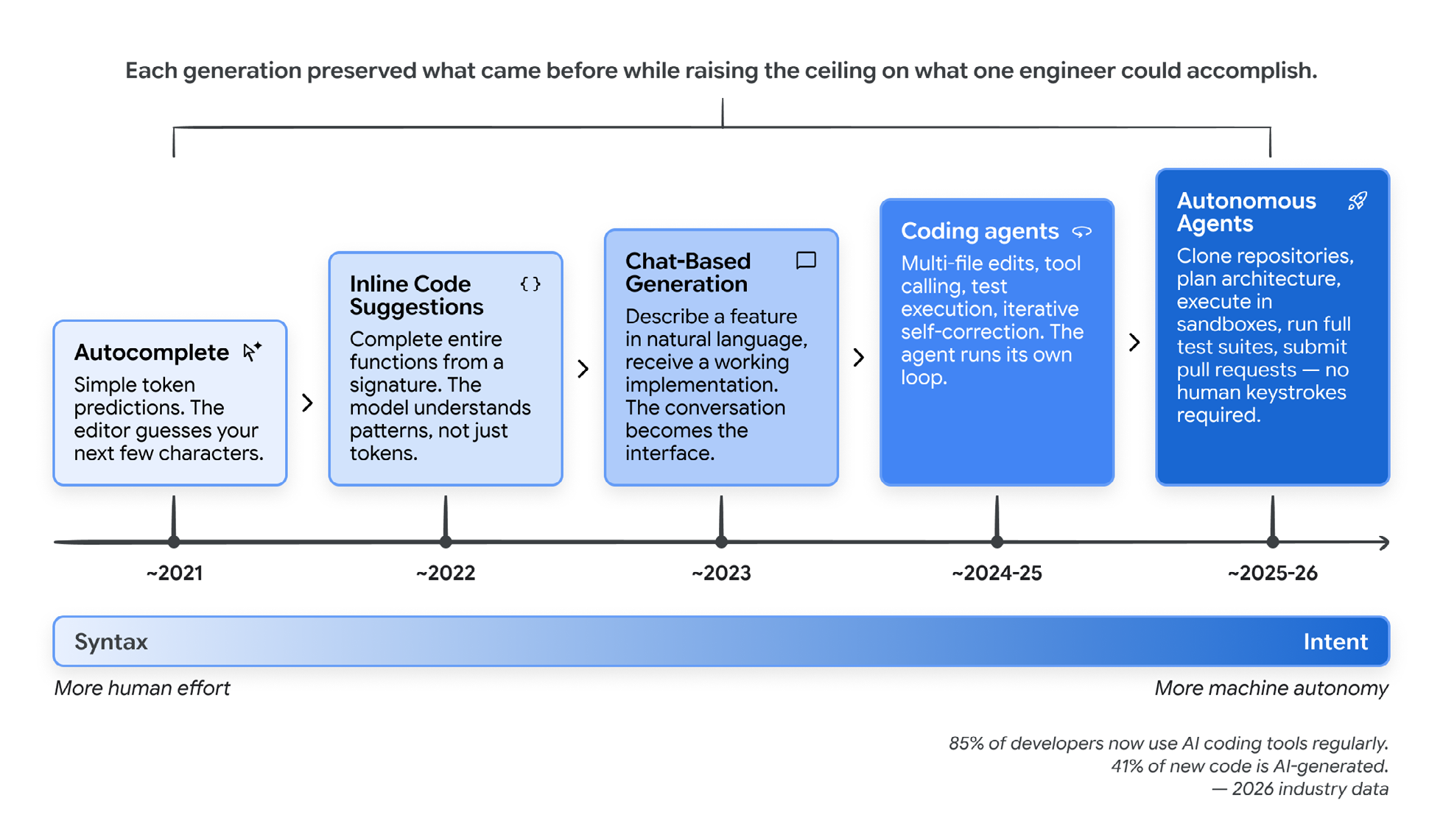
Four steps, from autocomplete to autonomy
It crept up one capability at a time, until the machine could do the whole job.
The core idea
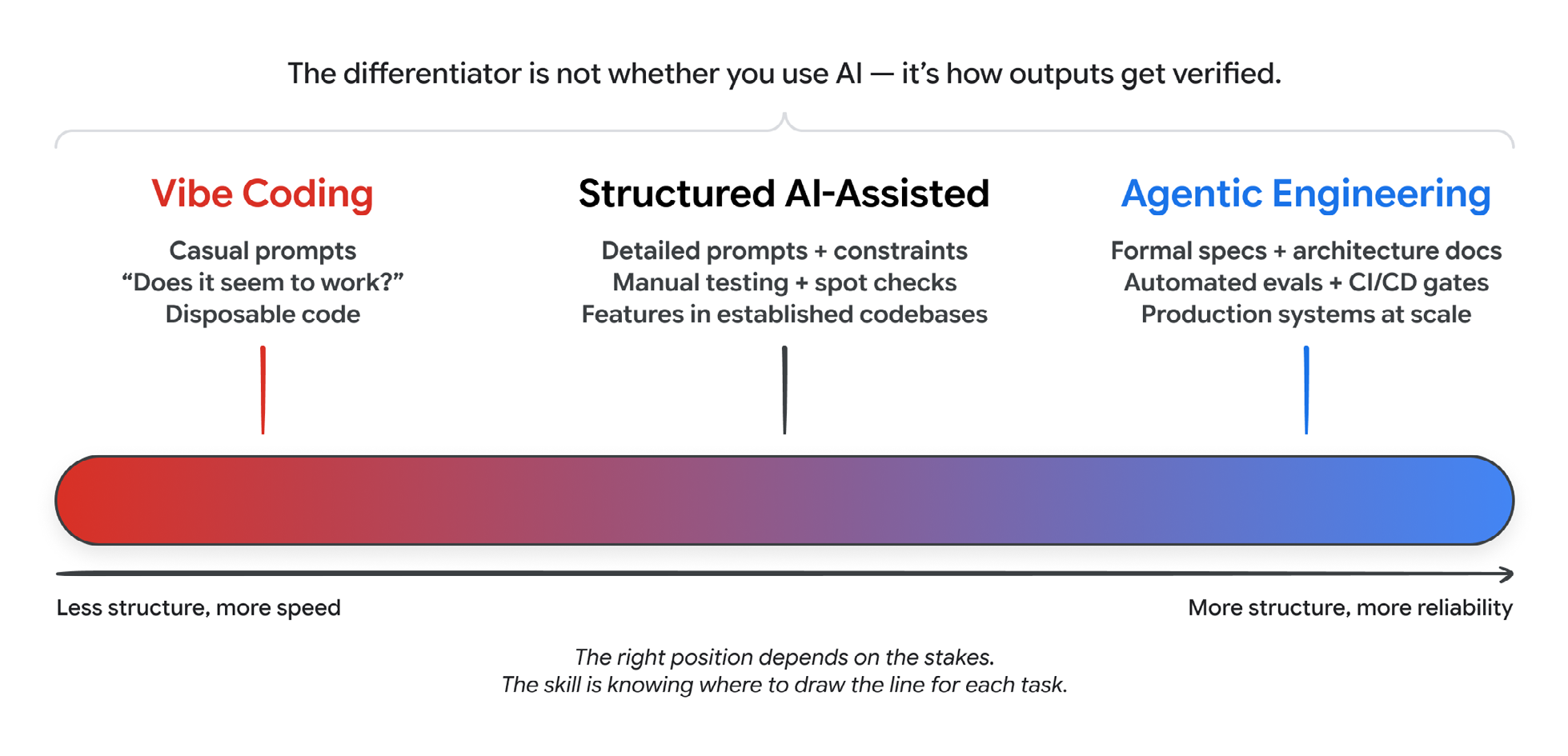
Vibe coding to agentic engineering: a spectrum
These are not two camps. They are two ends of one line. The real question is not whether you use AI. It is how much structure, verification, and human judgment surround its output.
Vibe coding
Describe it in plain words, accept what comes back, paste the error in when it breaks. Fast, loose, often you do not read the code.
prototypes · scripts · hackathonshigh risk, fine for disposable code
Structured AI-assisted
Detailed prompts with constraints, manual testing, selective review of the critical paths. Human judgment at the key checkpoints.
features in an existing codebasemoderate risk, the everyday middle
Agentic engineering
Formal specs, architecture docs, memory files. Automated test and eval suites, CI/CD gates. AI implements inside human-designed limits.
production · team scalelow risk, verified at every stage
What actually separates the two ends: verification. Tests check the deterministic parts (this input gives that output). Evals check the judgment parts (did the agent take the right steps and meet the quality bar). Without both, it is vibe coding, no matter how clever the prompts.
What is doing the work
The agent, and the skill of feeding it
An agent is not a chatbot. It runs its own loop. And the quality of what it builds depends less on clever prompts than on the context you give it.
The engine
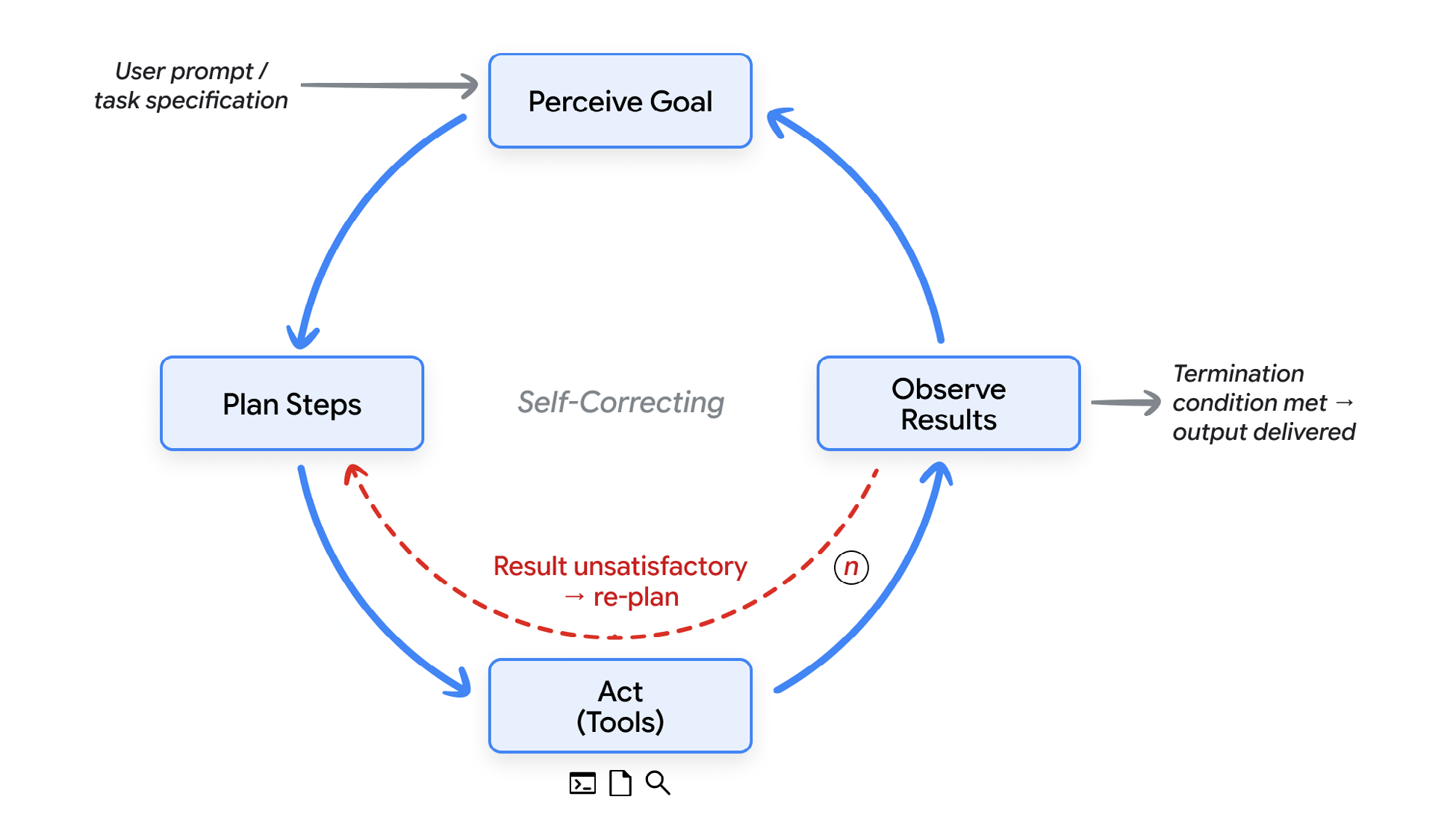
An agent runs a loop
Give it a goal at the top, and it decides each next move on its own.
The real skill
Context engineering beats prompt engineering
Models do not need clever wording. They need what a good new teammate would need to do the work.
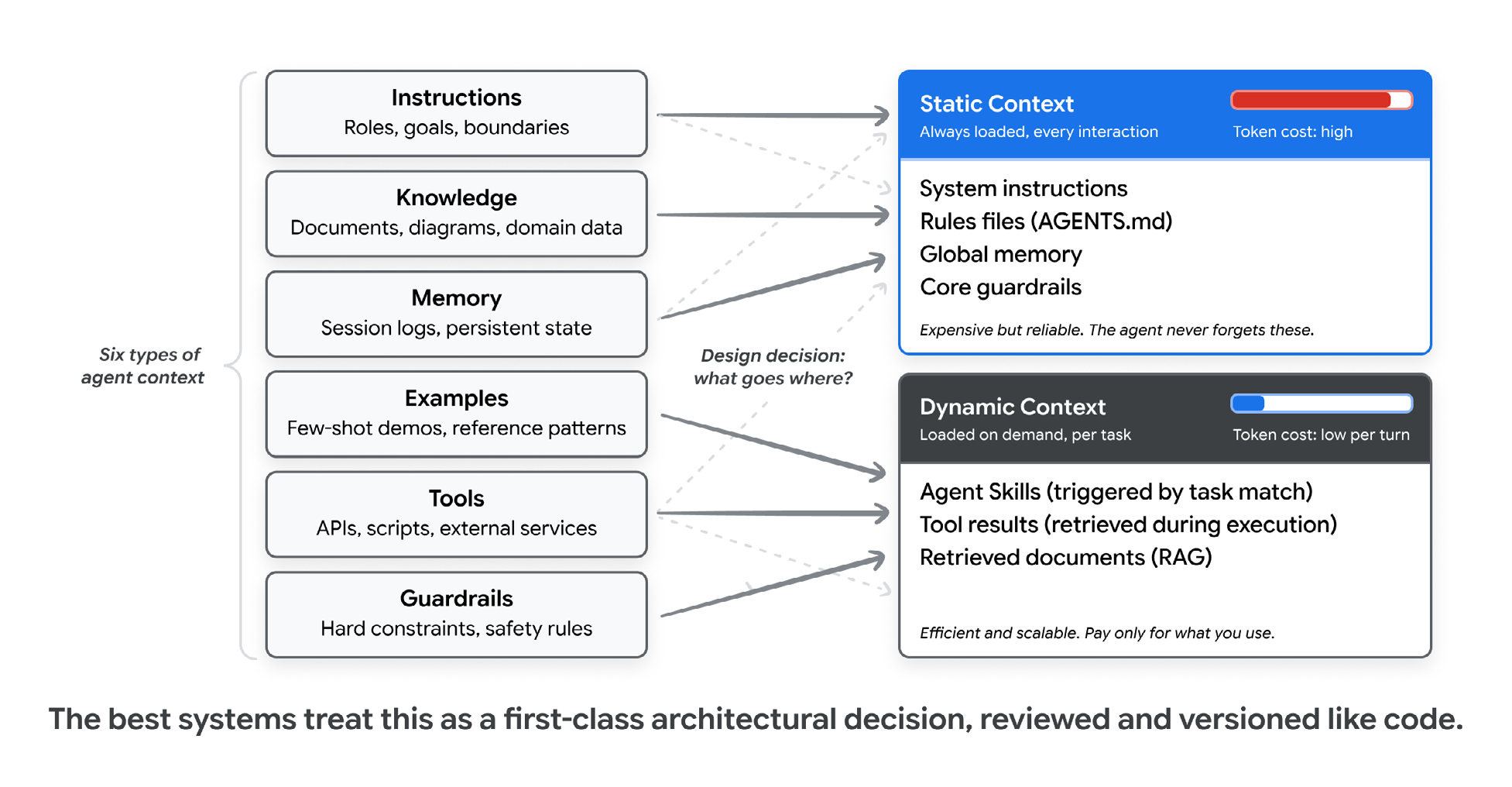
Six kinds of context every agent needs: instructions (its role and limits), knowledge (docs and data), memory (what just happened and what the project is), examples, tools, and guardrails. The pattern that scales this is Skills: portable packages the agent loads only when the task calls for it, so it stays a lightweight generalist that flexes into a specialist on demand.
The lifecycle, reshaped
Every phase changes, but not evenly
Implementation that took weeks now takes hours. Requirements, architecture, and verification stay stubbornly human-paced. The result is not a faster old SDLC. It is a different workflow.
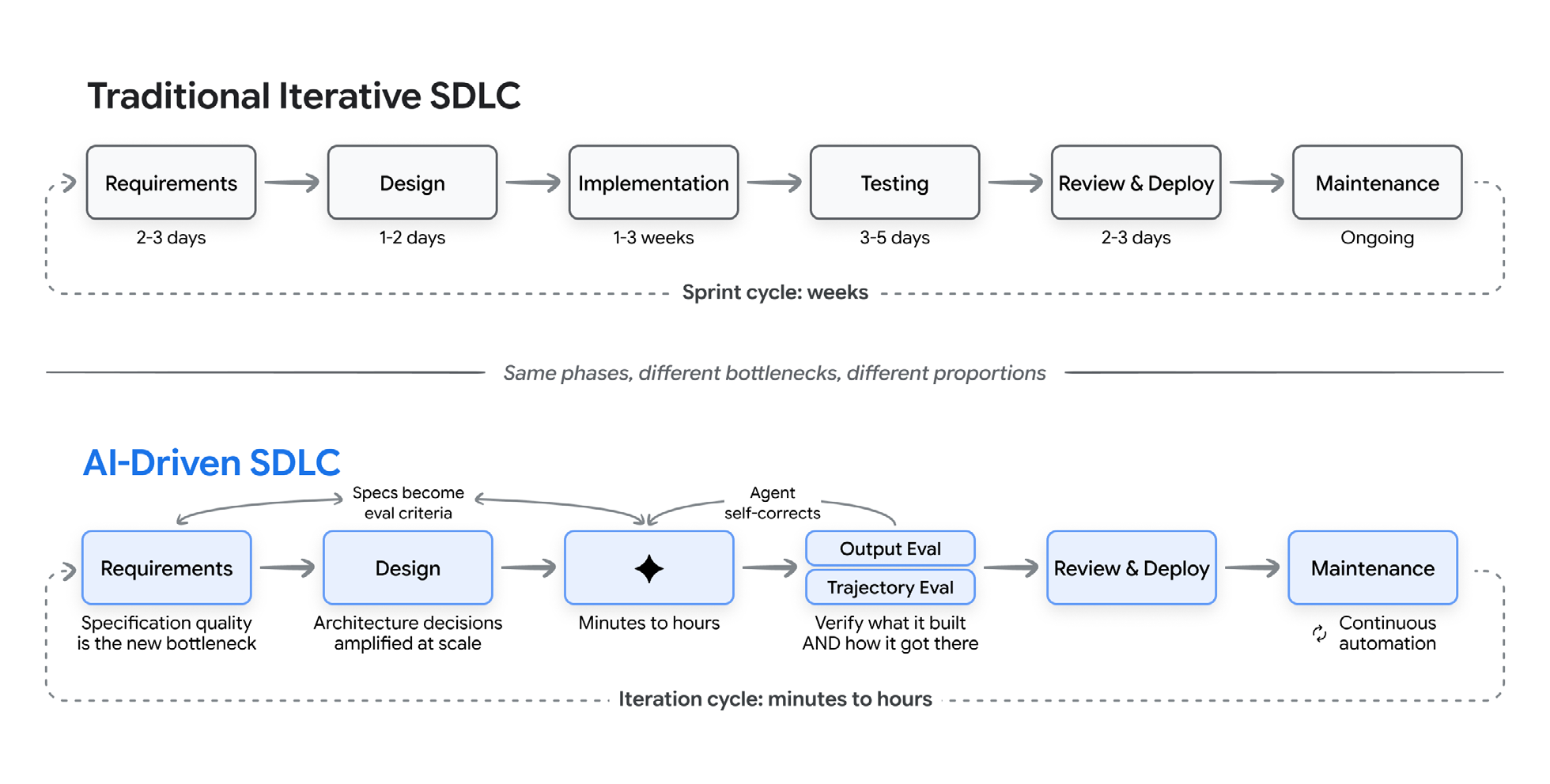
Requirements
From a document handed between teams to a conversation with AI that produces the spec and a working prototype at the same time.
Design & architecture
The most human phase. AI implements decisions fast, but the trade-offs stay yours to make and document.
Implementation
Real 25 to 39% gains, but one study found experts took 19% longer on some tasks. The work shifts from writing to reviewing and guiding.
Testing & QA
Check the result and the path it took. Tests and evals become the main way you tell the AI what "correct" means.
Review & deploy
AI is the first-pass reviewer for bugs, style, and security. Pipelines get AI-aware: monitor health, predict risk, auto-roll-back.
Maintenance
The most underrated shift. Code "too risky to touch" can now be read, refactored, and migrated. Old technical debt finally gets paid.
The mental model
Build the system that builds the software
Your main output stops being code. It becomes the factory that produces code: the specs, the agents, the tests, the feedback loops, the guardrails.
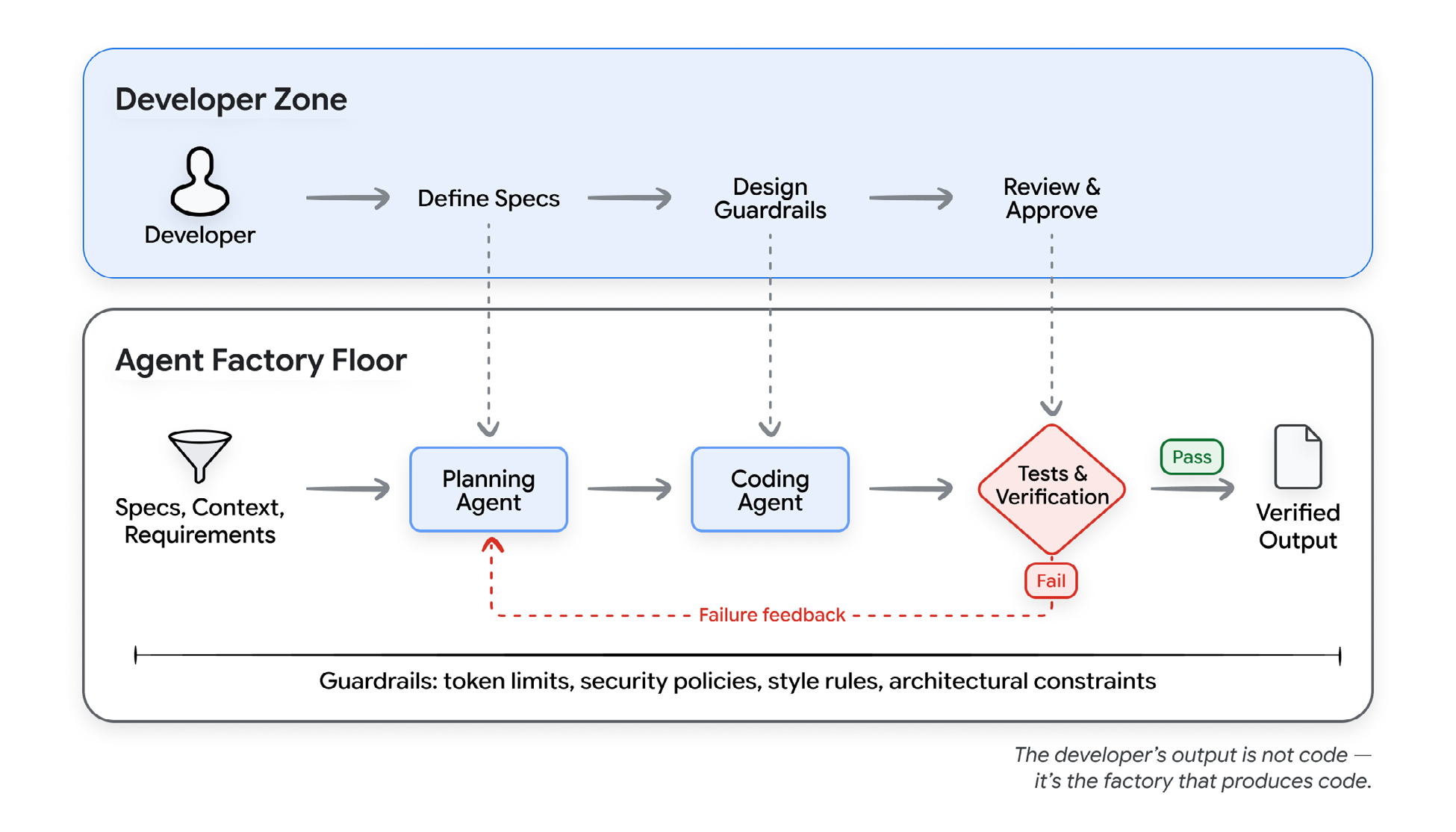
The machine on the floor
Agent = model + harness
The model is just the raw engine. The harness is everything wrapped around it that lets it finish the job.
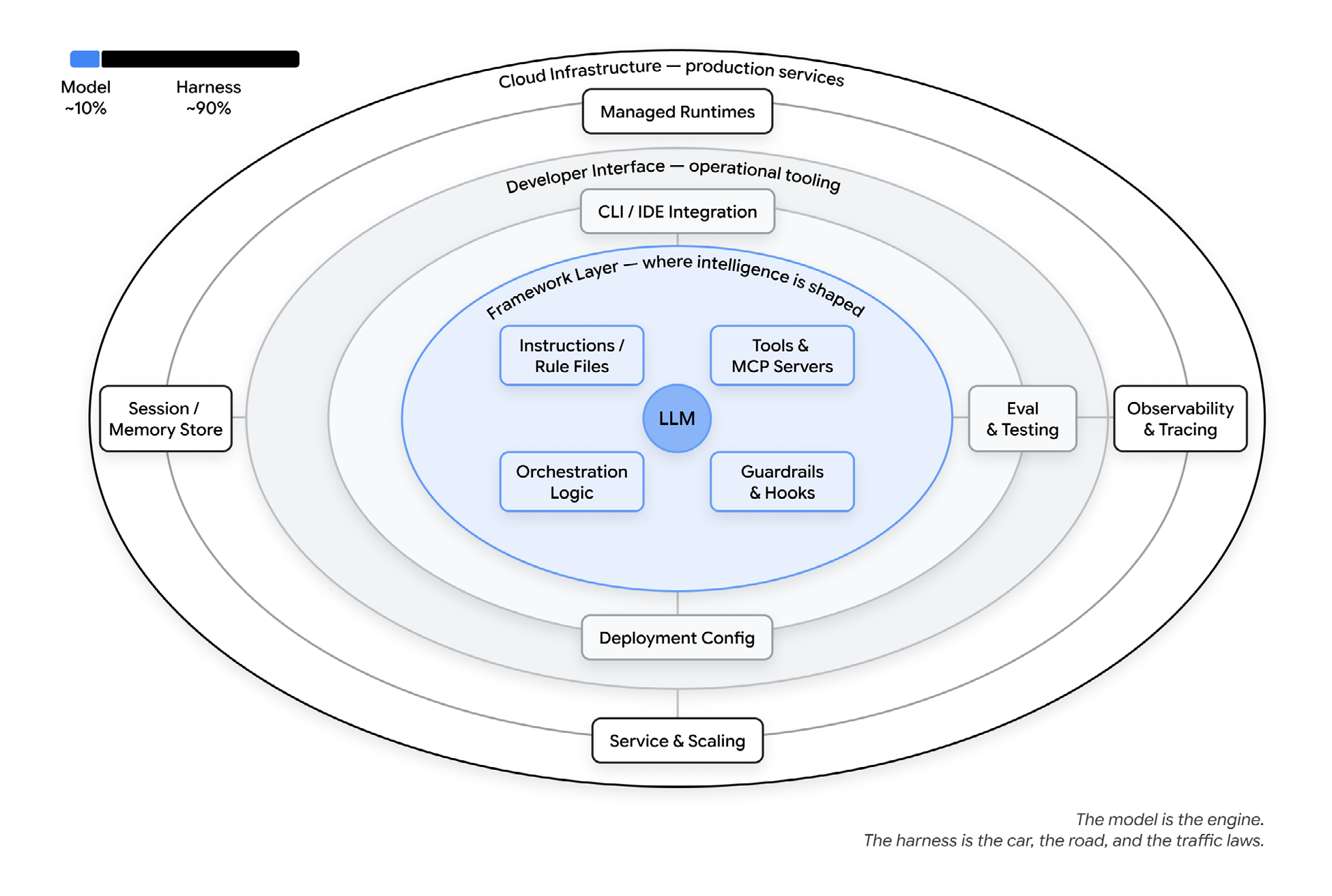
How much the harness matters: one team moved a coding agent from outside the Top 30 to the Top 5 on a public benchmark by changing only the harness, with no model change at all. The everyday lesson: when an agent does something wrong, you blame the model first, but most agent failures are configuration failures, a missing tool, a vague rule, an absent guardrail, or a context window stuffed with noise.
Your evolving role
Conductor and orchestrator
Two modes you move between. Hands-on the keys, or directing a team of agents working in the background.
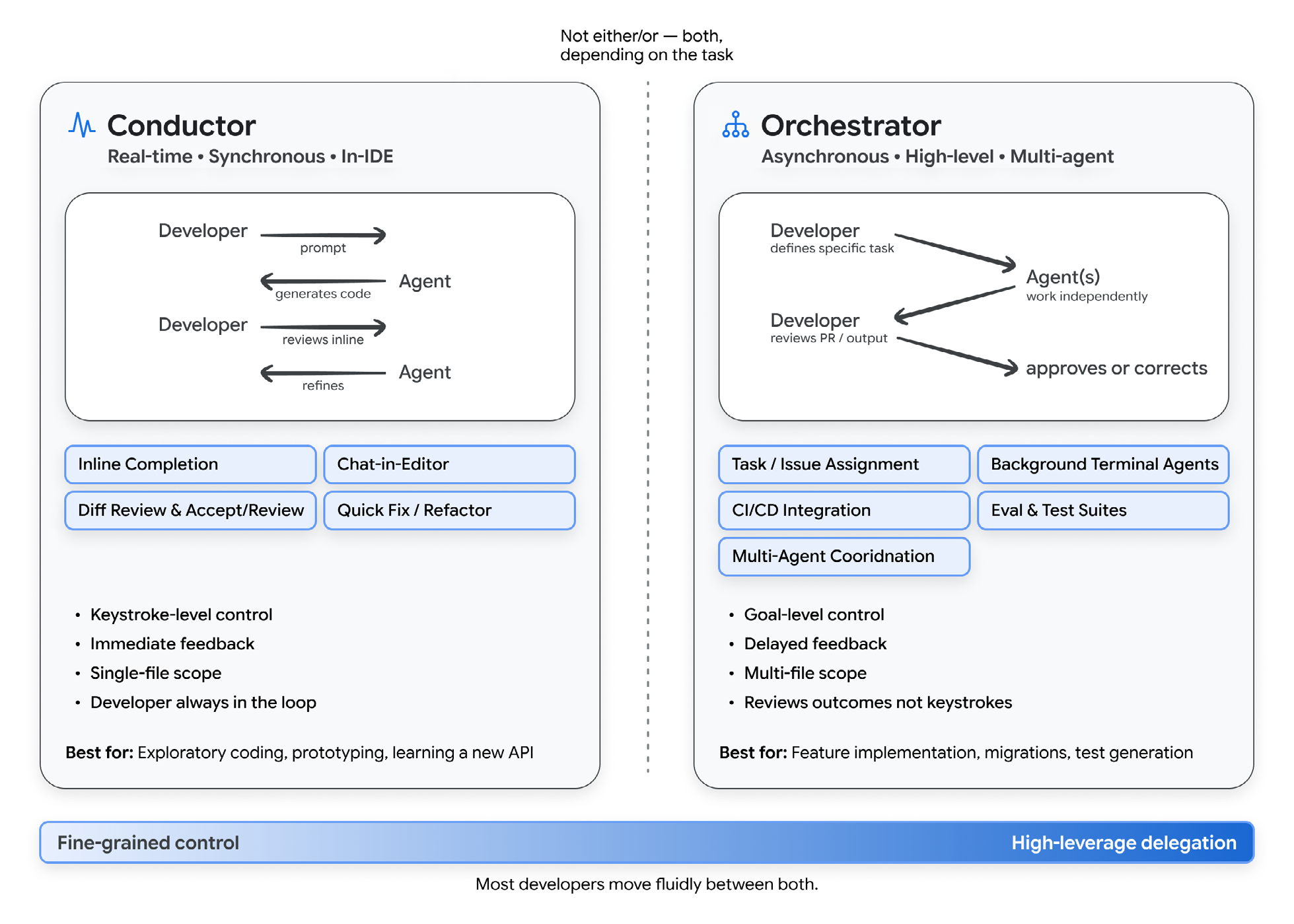
Conductor: hands-on, real-time
In the IDE, guiding the AI keystroke by keystroke. Natural for complex logic, tricky debugging, and unfamiliar code where you need to understand each change. The risk: you become the bottleneck.
Orchestrator: async, delegated
Define goals, hand them to agents working in parallel, review the output. Fits well-specified work: bug fixes, migrations, test generation. Demands new skills: specification, decomposition, evaluation, system design.
The 80% problem: agents quickly produce about 80% of a feature. The last 20%, the edge cases, error handling, and subtle correctness, needs deep context the model often lacks. The errors are sneaky because the code "looks right." The winning posture: use AI for what it is good at, and spend your attention where it struggles.
The money
Low cost to start is not low cost to own
For leaders, velocity is the wrong headline. Total cost of ownership is the real one, and the bill shows up later.
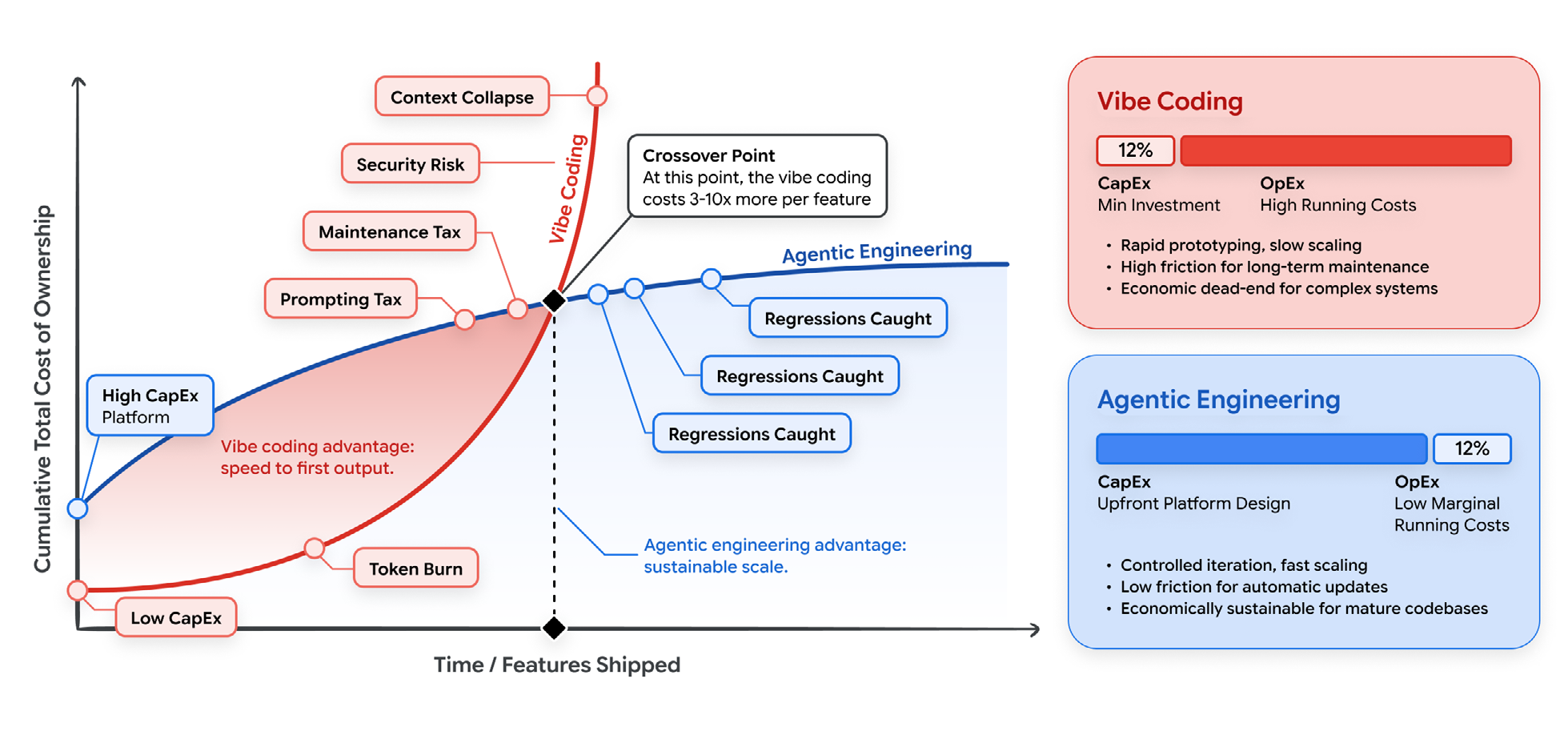
Vibe coding: low CapEx, high OpEx
Nearly free to start. But it hides a compounding bill: token burn from unstructured prompt-and-fix loops, a maintenance tax when humans reverse-engineer the "spaghetti" months later, and costly security fixes in production.
the hidden debtAgentic engineering: high CapEx, low OpEx
A deliberate upfront investment: API schemas, test suites, structured context. The marginal cost of shipping and maintaining each feature then drops sharply, because output is structurally sound and pre-tested.
the investmentContext engineering is a financial lever. A dense, high-signal payload raises the agent's first-pass success rate and avoids expensive trial-and-error. Model routing compounds it: big models for hard work, cheap fast models for test generation, review, and CI monitoring.
Where to start
The move that turns vibes into engineering
You do not need a transformation program. You need a few habits, starting this week.
Do this
- Write a 10-line AGENTS.md: stack, conventions, hard rules, workflow
- Write the tests and evals before the code. They are your contract with the AI
- Pick one repetitive workflow and make it your first agent
- Review every line that ships. Be skeptical of anything that looks clever
- Keep your own debugging and design skills sharp
Not this
- Vibe coding your payment processing or anything in production
- Accepting whatever the AI returns without reading it
- Shipping with no eval suite and no clear rubric
- Blaming the model before checking the harness
- Letting prototype and production work blur together
Structure scales, vibes don't
Vibes are fine for exploring. For software people depend on, the discipline is not optional.
AI amplifies your culture
It multiplies strong testing and clear standards, and it multiplies their absence just as fast.
Your role is evolving, not ending
The skill shifts from writing code to judgment: specs, evaluation, and designing the system.